

Visible
Baby’s eyes, nose, and mouth should be easy to see and above the the carrier so that fresh air flows freely around their face.

Kissable
Carry your baby positioned high enough on your chest that you can easily kiss the top of their head.
Babywearing safety is not hard or complicated. Carrying your baby safely in a sling, wrap, SSC, or other on-body baby carrier requires the same precautions and care as bouncer seats, handheld carseat carriers, strollers, swings, and any other nursery devices.
One of the best things about babywearing is that it allows you to keep your baby within sight at all times. Unlike swings, bouncers, carseats, strollers, or other devices, it is impossible to step away from a baby while you are using a babywearing carrier. This allows you to continually monitor and supervise your baby, and to quickly notice any changes in their breathing, coloring, temperature, etc.
However, as with any baby product, it is important to attend and protect your baby’s airway safety at all times, especially in the first 3 months of life when baby’s airway is particularly vulnerable and underdeveloped.
Visible and kissable: the keys to babywearing safety
The CPSC, BCIA, ASTM, CEN, and many other government and nonprofit organizations study and track adverse incidents that occur in nursery products. This information informs both babywearing safety standards and safety messaging to parents.
What we have learned from this data is that babies are safest when their faces are uncovered and visible to a caregiver. This is true for babywearing safety as well as other nursery devices. For this reason, when carrying babies in their first 3 months of life (and any time you are carrying a baby on your front), you should ensure your baby is both visible and kissable (R) for the adult carrying the baby.
Keep baby’s face VISIBLE
Baby’s eyes, nose, and mouth should be easy to see and above the the carrier so that fresh air flows freely around their face.
This may mean different things depending on the type of carrier a parent is using.
For carriers with a fixed-shape back panel, like a soft buckle carrier, it is important that that the panel is a good fit for your baby. An easy-to-remember tip is that when using a buckle carrier, your baby’s ears and nose should be higher than the panel. This accomplishes two things:
- Ensures baby has access to fresh air
- Ensures the carrier doesn’t push the baby’s head forward. The round, prominent back part of a baby’s skull is called the “occiput,” and having the occiput above the edge of the carrier means baby’s neck and airway can remain in a neutral position.
If the carrier panel comes higher than your baby’s occiput and is not adjustable, you should stop using the carrier until your baby has grown taller. Sometimes this is described as having the general carrier height lower than your baby’s ears, which tend to align with the base of the skull. If you are unsure, you can consult a babywearing educator or the product manufacturer.
Some styles of carriers, such as wraps, have wide straps that pass over the adult’s shoulders or attached “sleep hoods.” Parents will sometimes tuck a child’s head into these wide straps. In this case, baby’s face should be fully visible to the caregiver — eyes, nose, and mouth — and baby’s head and airway should be in a neutral position. The carrier should be open near baby’s face so that they can breathe fresh, oxygen-rich air at all times.

This image shows a baby with the neck and airway in a neutral, natural position, allowing baby to breathe easily.
Care must be taken in any baby holding device. The weight of a baby’s head can cause a kinked airway if it falls forward, backward, or sharply to the side.

The horizontal panel of the carrier is below baby’s nose and mouth, leaving the airway neutral and open to fresh air.
The fabric is below the base of the baby’s skull, leaving baby’s face fully visible and preventing the head from being pushed down and forward into their chest. The carrier provides head support so baby’s airway stays in a neutral position.

The wrap fabric is below baby’s nose and mouth, baby’s face is fully visible to the caregiver and open to fresh air, and the baby’s face is turned away from the caregiver’s body.
Although the panel is supporting the back of baby’s head, the skull and airway are aligned in a neutral position.
Baby’s head should be easily KISSABLE
Carry your baby positioned high enough on your chest that you can easily kiss the top of their head. This is especially important with babies under 4 months old, but any time you are carrying your baby on your front, this is a good babywearing safety rule to follow.
Position baby in the carrier as you would in your arms: head at your collarbone; bum at or above your waist.
After securing the carrier, hug the baby. If you instinctively move them higher or closer, adjust carrier until it holds baby in the position you use when carrying them in your arms.
When feeding your baby in a carrier, support baby’s head and observe them closely. Return to upright position after feeding.
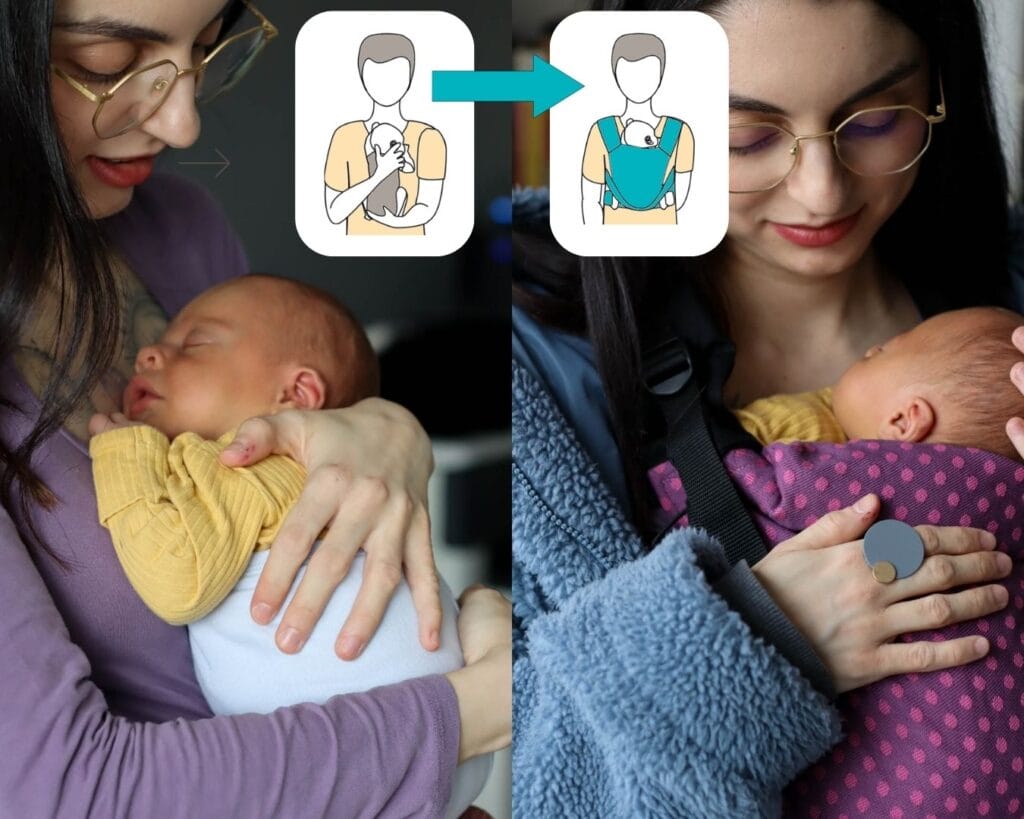
The first image shows baby being held in mother’s arms, close enough that she can kiss the top of their head. In the second image, the baby is being held in the same position, but this time the baby is buckled into a soft carrier.
Protect the airway
Baby’s neck should be in a neutral position with their head supported by the adult’s body.
Babies can suffocate If the weight of their head falls forward, backward, or to the side without adequate support.
Reposition if you notice changes to baby’s coloring or breathing.
Consult your medical provider if your baby was premature, has respiratory issues, or if you notice ongoing changes to baby’s breathing.

Normal breathing vs. cause for concern
Parents sometimes ask what “normal breathing” sounds like, especially if their baby is a “noisy breather.” The BCIA recommends always removing the baby from the carrier and repositioning if you notice any change in their breathing that causes concern.
The following information about infant breathing noises are taken directly from the Children’s Hospital of Minnesota.
Normal breathing sounds in babies
Some breathing sounds with your baby are typical for infants and are not cause for concern.
- Infant snorts and mild congestion, especially during sleep
- Baby gurgling sound in throat from saliva or mucus
- Newborn breathing loudly (especially after feeding)
- Baby breathing sounds like snoring while awake or during sleep. Newborn fast breathing during sleep – babies often breathe faster or heavier while sleeping.
It’s important to always monitor your baby’s symptoms and call your pediatrician if you have questions. If your baby’s breathing is accompanied by blue lips or skin, difficulty feeding, poor weight gain, or pauses in breathing, seek medical attention immediately.
Abnormal breathing in babies
- Labored breathing in infants: visible effort, such as tugging at the neck or stomach.
- Stridor in infants: a persistent high-pitched, harsh or squeaky sound when breathing in.
- Wheezing noise in newborns: especially if it’s continuous or accompanied by rapid breathing.
- Newborn breathing heavy or raspy that doesn’t improve.
- Infant rattling breathing that is persistent or worsening.
Order or print babywearing safety brochures from the BCIA
The BCIA has created a free educational babywearing safety brochure based on our “Visible and Kissable” (R) campaign. This is a great resource to share with healthcare providers, midwives, doulas, at babywearing meetings, and with anyone else you think could benefit from clear information.
You can print it on your home printer, and we offer these brochures free to BCIA members for the cost of shipping. If you are an educator or nonprofit group and would like to request printed brochures, we may be able to help you — you can reach out to us on our contact page with your request.